
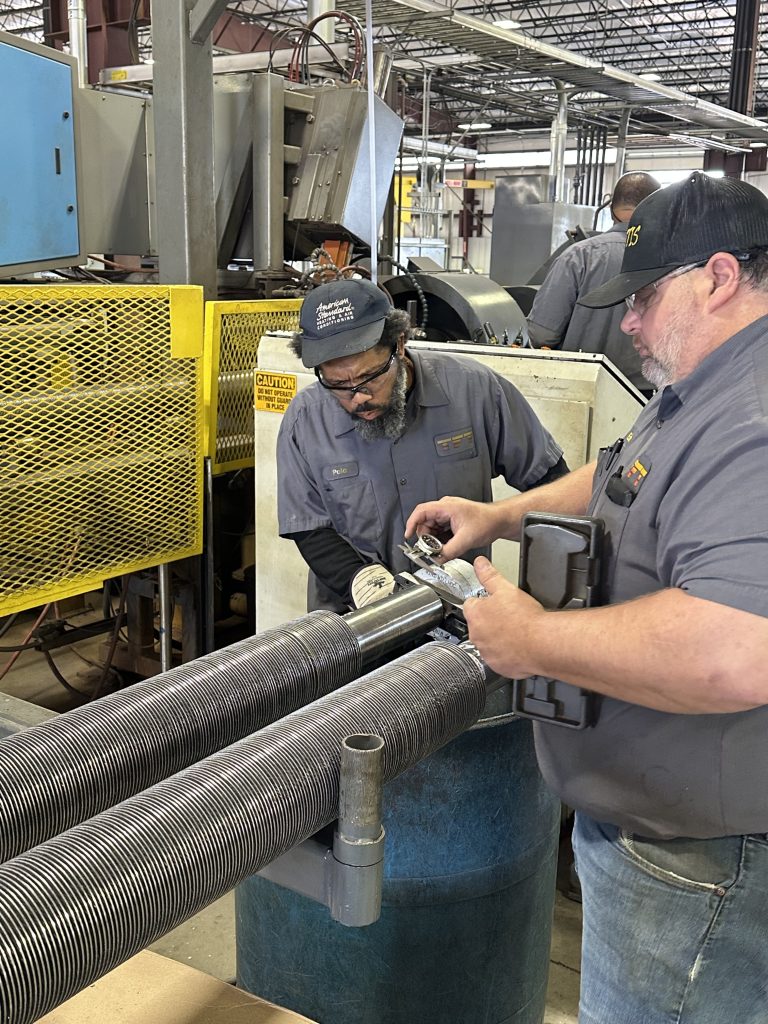
Guide to Heat Exchanger Maintenance: Ensuring Long-Term Performance
Heat exchangers handle some of the most demanding thermal work in industrial operations. They transfer heat between fluids continuously, often under high pressure and temperature. Because of this, heat exchanger maintenance directly affects system efficiency, operational safety, and long-term equipment life.
At Tulsa Fin Tube, we manufacture high-frequency welded finned tube products for heat exchangers across multiple industries. We understand how finned tube quality affects long-term performance. In addition, we recognize that consistent maintenance practices are what protect that investment over the years.
This guide covers the core maintenance strategies for heat exchangers: what to watch for, how to address it, and why each step matters.
Why Heat Exchanger Maintenance Cannot Be Deferred
Heat exchangers degrade over time. This is not a flaw — it is simply the nature of equipment that operates continuously under thermal and mechanical stress.
However, the rate of degradation depends heavily on how well the system is maintained. According to the Heat Transfer Research Institute, fouling alone can reduce heat exchanger thermal efficiency by 10 to 25 percent in heavy industrial applications. Moreover, deferred maintenance compounds the problem. Small issues that go unaddressed become larger failures that force extended downtime.
Furthermore, the cost of reactive maintenance consistently exceeds the cost of preventive maintenance. Planned cleaning, inspection, and component replacement are far less expensive than emergency shutdowns, tube bundle replacements, or full system overhauls.
In short, heat exchanger maintenance is not optional. It is the discipline that determines how long a system performs at specification.
The Main Threats to Heat Exchanger Performance
Before addressing maintenance strategies, it helps to understand what actually causes heat exchanger performance to decline. Three issues account for the majority of problems.
Fouling
Fouling is the accumulation of unwanted deposits on heat transfer surfaces. These deposits act as an insulating layer. As a result, they reduce the rate of heat transfer between fluids. Fouling takes several forms. Mineral scale builds up from hard water. Biological fouling develops in systems where microorganisms grow. Particulate fouling occurs when suspended solids settle on tube surfaces. Each type requires a different cleaning approach.
Corrosion
Corrosion degrades the tube material itself. It can cause wall thinning, pitting, and eventually perforation. Consequently, corrosion leads to leaks, cross-contamination between fluid streams, and structural failure. The rate of corrosion depends on the tube material, the fluid chemistry, and operating temperatures. Nevertheless, even corrosion-resistant alloys require monitoring. Without regular inspection, corrosion damage can progress undetected until it causes a failure.
Mechanical Wear
Beyond fouling and corrosion, heat exchangers experience mechanical wear over time. Seals and gaskets harden and lose their sealing ability. Tubes experience vibration fatigue. Supports and baffles can shift under repeated thermal cycling. Therefore, mechanical wear requires its own inspection and replacement schedule. It is not addressed through cleaning alone.
Core Heat Exchanger Maintenance Strategies
1. Regular Cleaning
Cleaning is the most fundamental heat exchanger maintenance task. Its frequency depends on the process fluid, the fouling tendency of the system, and operational history.
Three cleaning methods cover most industrial applications:
- Chemical cleaning — circulating chemical solutions to dissolve scale and mineral deposits. This method works effectively for systems with heavy mineral fouling and is less disruptive than mechanical methods.
- Mechanical cleaning — physical removal of deposits using brushes, scrapers, or hydroblasting tools. This approach is thorough and well-suited for systems with stubborn fouling that chemical cleaning cannot fully address.
- High-pressure water jetting — using pressurized water streams to clear tube interiors and external surfaces. This method handles a wide range of fouling types quickly.
Regardless of the method used, cleaning intervals should be based on actual fouling data rather than arbitrary schedules. Furthermore, post-cleaning inspection confirms that the cleaning was effective before the system returns to service.
2. Inspection and Monitoring
Routine inspection catches problems before they escalate. In addition, it provides the performance data needed to refine cleaning intervals and maintenance schedules over time.
Key inspection methods include:
- Visual inspection — direct examination of accessible surfaces for signs of corrosion, fouling, leakage, or physical damage. Visual checks are the fastest way to identify obvious problems during scheduled outages.
- Pressure testing — pressurizing the system to check for leaks. A pressure drop during testing indicates a breach in the heat exchanger that requires investigation.
- Thermal imaging — using infrared cameras to map temperature distribution across the heat exchanger. Uneven temperature patterns indicate blocked tubes, flow maldistribution, or areas of significant fouling.
- Eddy current testing — a non-destructive method for detecting tube wall thinning, pitting, and corrosion without requiring tube removal. This technique is especially valuable for assessing tube condition in large heat exchangers.
According to the Tubular Exchanger Manufacturers Association, scheduled inspection intervals should reflect the severity of the operating environment. Systems running with aggressive process fluids or high-temperature differentials warrant more frequent assessment.
3. Preventive Component Maintenance
Cleaning and inspection address performance and detection. However, preventive component maintenance addresses the physical elements that degrade regardless of fouling levels.
Key preventive tasks include:
- Gasket replacement — gaskets harden and compress over time, losing their sealing capability. Replacing them on a defined schedule prevents leaks before they develop.
- Tube plugging — when individual tubes show damage or leakage, plugging them temporarily isolates the problem while the system remains in service. This approach extends the useful life of the tube bundle until a full replacement is justified.
- Lubrication of ancillary components — fans, pumps, and other moving parts associated with the heat exchanger system require regular lubrication to prevent mechanical wear.
4. Operational Parameter Management
Maintenance is not limited to what happens during shutdowns. In fact, how a heat exchanger operates day-to-day directly affects how quickly it degrades.
Two operational factors deserve consistent attention:
- Flow rate management — operating outside the design flow range accelerates fouling and mechanical wear. Consequently, maintaining flow rates within specification reduces the rate of degradation between maintenance intervals.
- Temperature monitoring — tracking inlet and outlet temperatures provides a continuous performance indicator. A narrowing temperature differential between streams signals declining heat transfer efficiency, often indicating fouling that requires attention.
5. Chemical Treatment Programs
For many systems, chemical treatment is a cost-effective way to slow fouling and corrosion between cleaning cycles. Two types are most commonly used:
- Corrosion inhibitors — added to the process fluid to reduce the rate of material degradation on tube surfaces. These are especially valuable in systems handling chemically aggressive fluids.
- Scale inhibitors — chemical additives that prevent mineral deposits from forming on heat transfer surfaces. Moreover, they reduce the frequency of cleaning required to maintain thermal performance.
Chemical treatment programs should be matched to the specific fluid chemistry and materials of the heat exchanger. Therefore, consulting with a chemical treatment specialist before establishing a program is advisable.
The Role of Finned Tube Quality in Long-Term Maintenance
Heat exchanger maintenance addresses what happens after installation. However, the quality of the finned tube components used in the system determines how much maintenance will be required.
High-frequency welded finned tubes with strong fin-to-tube bonds maintain their heat transfer surface area over time. Tubes with poor fin attachment lose fins through thermal cycling and vibration, which reduces heat transfer efficiency and increases the frequency of maintenance required to compensate.
At Tulsa Fin Tube, we produce continuous high-frequency welded finned tube products to customer specifications, using solid state welding technology that creates a metallurgical bond between fin and tube. In addition, every order goes through multiple quality checks before leaving our facility.
For heat exchanger operators, sourcing finned tube components from a manufacturer with documented quality processes reduces long-term maintenance burden. It also extends the intervals between major interventions.
Building a Heat Exchanger Maintenance Program
Effective heat exchanger maintenance is not a one-time event. Rather, it is an ongoing program built around the specific characteristics of each system.
A well-structured program includes:
- A documented baseline of the system’s performance at commissioning for comparison against future inspection data
- Defined cleaning intervals based on fouling history rather than generic schedules
- Scheduled inspection at each maintenance outage using the appropriate non-destructive testing methods
- A component replacement schedule for gaskets, seals, and other wear items
- Operational monitoring between outages to detect performance changes before they require emergency action
Furthermore, maintenance records should be retained over the full service life of the heat exchanger. Trending performance data over time reveals patterns that allow maintenance intervals to be refined and problems to be anticipated rather than reacted to.
Contact Tulsa Fin Tube
Tulsa Fin Tube has supplied finned tube products to heat exchanger manufacturers and operators worldwide for more than 40 years. As the North American leader in high-frequency finning capacity, we produce finned tube and pipe products to meet the precise specifications that heat exchanger performance requires.
If you need finned tube components for a new heat exchanger or a replacement tube bundle, our team is ready to help. Contact Tulsa Fin Tube to request a quote or discuss your project requirements. Call us at (918) 834-2366 or visit us at 2991 N Osage Dr, Tulsa, OK 74127.
Author: Austin Hoose