
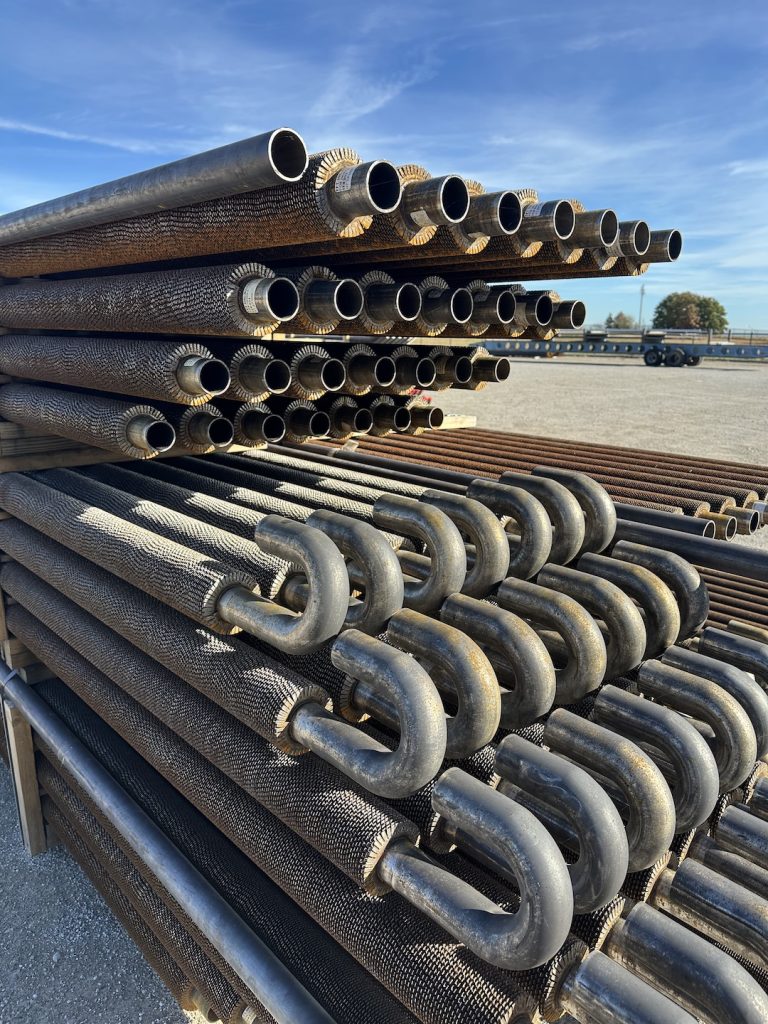
What Makes High-Quality Finned Tubes: The Manufacturing Factors That Matter
Not all finned tubes perform the same under load. Two tubes can look identical on paper — same fin height, same fin density, same base tube spec — and deliver meaningfully different results in service. The difference almost always comes down to how the fin attaches to the tube.
Engineers and procurement teams sourcing high-quality finned tubes need to understand what separates a well-manufactured tube from a marginal one. That distinction affects heat transfer efficiency, equipment longevity, and maintenance intervals. At Tulsa Fin Tube, we’ve manufactured high-frequency welded finned tubes for over 40 years. Here’s what that experience tells us about what actually matters.
Why the Fin-to-Tube Bond Is Everything
The fin on a finned tube does one thing: it increases external surface area for heat transfer. A mechanically attached fin transfers heat through contact pressure. That contact degrades over time. Thermal cycling, vibration, and high-temperature service all loosen the fit. Contact resistance grows. Efficiency drops.
A forge-welded fin works differently. High-frequency resistance welding (HFRW) fuses the fin directly to the tube surface. No filler material, adhesive, or separate weld bead. The process creates a true metallurgical bond between parent metals.
That bond doesn’t loosen with thermal cycling. It holds the same way in year five as it does at commissioning. This is why high-frequency welded finned tubes became the standard for demanding heat transfer applications. The evolution of finned tube manufacturing reflects this shift directly: the industry moved toward HF welding because the bond quality proves superior over the full service life of the equipment.
How High-Frequency Resistance Welding Works
The HFRW process relies on two electrical phenomena. Together, they concentrate heat precisely at the weld point — and nowhere else.
Skin Effect
High-frequency current concentrates at the surface of a conductor. It doesn’t distribute through the cross-section. In finned tube manufacturing, this keeps heat at the outer tube surface and the fin edge — exactly where the weld forms. The process uses less total energy, and the heat-affected zone stays tight.
Proximity Effect
HF current in adjacent conductors concentrates on the surfaces facing each other. In the finning process, the fin converges toward the tube in a V-shape. Current flows down the inner edge of the fin and back along the tube surface beneath it. It concentrates heat at the contact point just before the weld forms.
By the time the fin reaches the weld point, both surfaces sit at welding temperature. The process uses the minimum energy needed. The result is less thermal distortion, a smaller heat-affected zone, and a cleaner bond along the full tube length.
The Variables That Separate Good Welds from Marginal Ones
The process fundamentals are straightforward. What separates high-quality finned tubes from marginal ones is consistent execution of the details.
Thermal Balance Between Fin and Tube
The fin and tube have different thermal masses. The tube draws heat away from the weld point faster than the fin does. A well-controlled HFRW process compensates by adjusting the current path. Current travels a longer path on the tube surface than on the fin edge. Each unit of tube surface receives heat longer than the equivalent fin area.
This keeps both surfaces reaching welding temperature at the same moment. When the balance is off, one side heats faster than the other. The bond quality suffers.
Weld Power
Every fin-and-tube combination has an optimal weld power. It’s the minimum power that produces a complete, consistent weld. Too little power leaves the bond incomplete. The fin attaches but never truly fuses. Too much power makes the weld erratic. It produces excess spume and widens the heat-affected zone.
The right indicator is a continuous, moderate spume — small metal particles the electromagnetic forces eject from the weld V. Steady spume means the weld point hits the right temperature consistently. Uneven spume signals a problem.
Coolant Control and Spume Management
Spume needs active management. Coolant directed at the weld point prevents buildup in the deforming wheels and keeps the weld zone clean. On stainless steel and high-alloy materials, this step matters more. Stainless spume forms small, hard spherical particles. Without proper coolant control, those particles cause surface defects. Consistent coolant application is a quality control requirement, not a housekeeping task.
Why Material Capability Matters for Finned Tube Quality
High-quality finned tubes start with material compatibility. The fin and tube materials must weld cleanly by HFRW, and process parameters must dial in for each combination. Tulsa Fin Tube manufactures finned tubes in carbon steel, intermediate alloys, stainless steel, nickel alloys, and duplex materials. Solid and serrated fin profiles cover the full material range. Finning capabilities include tube diameters from 1″ to 8.625″ OD, fin heights from .25″ to 1.5″, and densities from 1 to 8 fins per inch.
Each alloy combination requires different process adjustments. Current frequency, contact placement, weld speed, and coolant management all shift depending on the materials. Experience and process control matter as much as equipment capability. A carbon steel tube in a waste heat recovery system and a stainless tube in a corrosive process environment both demand the same weld quality standards. When the standard range doesn’t fit the application, custom finned tube specifications match the exact requirements.
What High-Quality Finned Tubes Mean for System Performance
Engineers specifying finned tubes for a heat exchanger, boiler, economizer, or fired heater need performance that holds over time — not just at startup.
A forge-welded fin keeps the same thermal contact resistance throughout the equipment’s service life. Contact doesn’t loosen. No temperature differential develops between the fin base and the tube wall. Efficiency doesn’t drift as the equipment ages. The heat transfer surface performs the same way in year five as it does on day one.
This consistency matters most in high-temperature, high-cycling applications. Fired heaters, HRSGs, and process heat exchangers expose mechanical attachment methods to conditions that accelerate degradation. Welded fins hold. It also simplifies heat exchanger maintenance planning. Equipment built around high-quality welded finned tubes delivers predictable performance characteristics that support accurate inspection intervals and lifecycle cost modeling.
Tulsa Fin Tube operates six high-frequency finning lines with solid state technology. TFT was the first manufacturer in the United States to adopt solid state technology for fin tube production. Six lines running 24/7 means the capacity to meet tight project timelines without compromising process control. If you’re sourcing high-quality finned tubes for an upcoming project, request a quote or contact our team to discuss your specifications.
Frequently Asked Questions
What makes a finned tube high quality?
The primary quality factor is the fin-to-tube bond. A forge-welded fin creates a true metallurgical bond without filler material. It holds its thermal contact characteristics throughout the service life of the equipment. Mechanically attached fins loosen under thermal cycling and vibration. Their performance degrades over time. Secondary quality factors include material consistency, fin geometry tolerance, weld power control, and process monitoring throughout production.
What is high-frequency resistance welding for finned tubes?
HFRW continuously welds a helical metal fin to the outside of a tube. HF current concentrates heat at the contact point through the skin effect and proximity effect. When the fin reaches the weld point, both surfaces sit at welding temperature. Pressure fuses them together without filler material. The process controls the heat-affected zone tightly and produces consistent weld quality along the full tube length. Learn more about Tulsa Fin Tube’s process.
What materials work for high-quality finned tubes?
Material selection depends on the application. Tulsa Fin Tube produces finned tubes in carbon steel, intermediate alloys, stainless steel, nickel alloys, duplex, and other weldable materials. Fin profiles include solid and serrated options across the full material range. See the full finning capabilities for diameter, fin height, fin density, and material specifications.
What industries use high-quality finned tubes?
High-frequency welded finned tubes serve wherever heat transfer demands performance. Heat exchangers, boilers, economizers, fired heaters, HRSGs, kiln dryers, asphalt applications, and water evaporators all rely on finned tube technology. The fin geometry, tube material, and fin material vary based on operating temperatures, pressures, and fluid characteristics.
How does Tulsa Fin Tube ensure consistent weld quality?
Tulsa Fin Tube produces every finned tube to customer specifications. Multiple quality checks run throughout each production order. Six finning lines on solid state technology maintain consistent process parameters across all production runs. The quality management system targets continuous improvement in manufacturing effectiveness. Contact us to discuss quality documentation requirements for your project.
Author: Austin Hoose