
How Do Fin Tubes and Heat Exchangers Work Together?
Heat exchangers move thermal energy between two fluids. That much is straightforward. What determines how efficiently they do it is surface area — specifically, how much contact surface sits between the process fluid and the heat transfer medium.
Fin tubes solve that problem directly. Understanding how fin tubes and heat exchangers work together explains why finned tubes appear in so many industrial heat transfer systems — and why the quality of the fin-to-tube bond matters as much as the tube material or fin geometry. At Tulsa Fin Tube, we’ve manufactured high-frequency welded finned tubes for over 40 years across a wide range of heat exchanger applications. Here’s how the relationship between fin tubes and heat exchangers actually works.
The Core Problem: Bare Tubes Move Heat Slowly
A bare tube in a heat exchanger transfers heat through its outer surface. That surface area is fixed by the tube’s diameter and length. For many applications, it isn’t enough.
Air-side heat transfer compounds the problem. Air has low thermal conductivity and density compared to liquids. Moving heat from a hot tube surface into an airstream — or from a hot airstream into a cooler tube — requires a lot of contact area to achieve meaningful heat transfer rates. A bare tube simply doesn’t provide it.
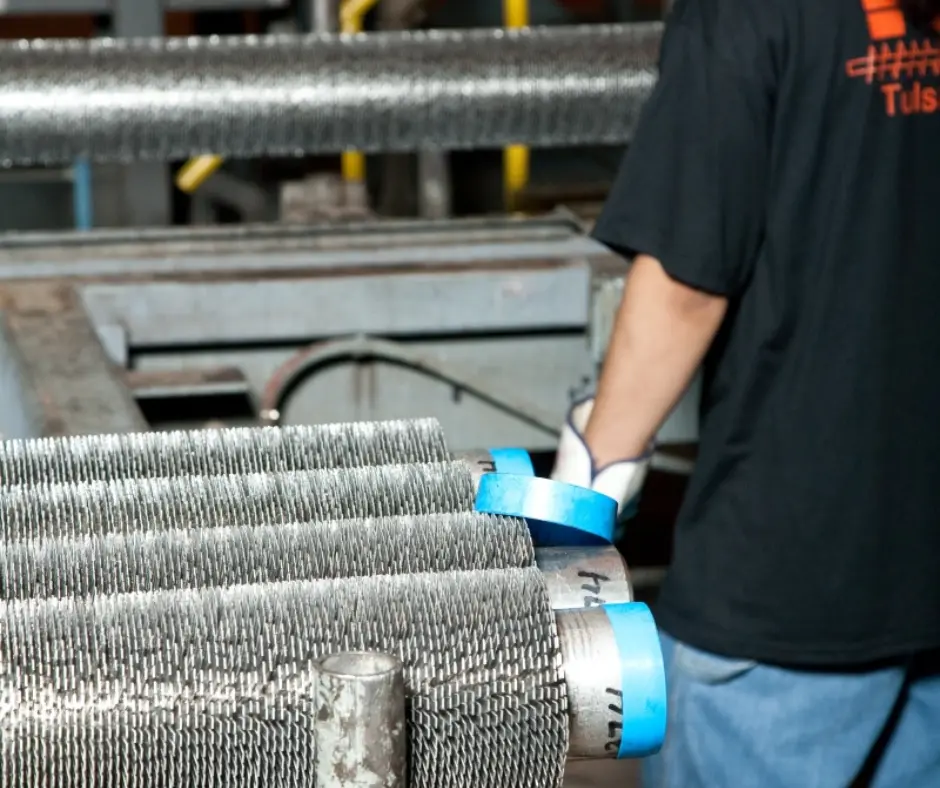
This is the core constraint fin tubes solve. Adding helical fins to the outside of a tube dramatically increases the external surface area without changing the tube’s footprint. More surface area means more heat transfer capacity from the same tube length and diameter.
How Fin Tubes and Heat Exchangers Work Together
In a finned tube heat exchanger, one fluid flows inside the tube. Another fluid — often air or a gas — flows across the outside of the finned tube bundle. Heat moves from the hotter fluid to the cooler one through the tube wall and the fins.
The fins extend the effective surface area of each tube. Heat conducts from the tube wall outward through the fin. From the fin surface, it transfers into the surrounding fluid by convection. The larger the fin surface, the more heat the system can move per unit of tube length.
This is how fin tubes and heat exchangers work together to achieve performance that bare tubes alone cannot reach. The finned tube radiator is one of the most familiar examples — a compact unit that transfers significant heat into an airstream precisely because the fins multiply the effective surface area far beyond what bare tube could provide.
What Fin Geometry Does to Heat Transfer Performance
Not all fins perform identically. Fin geometry directly affects how much heat a finned tube moves and how the surrounding fluid flows across the surface.
Fin Height
Taller fins add more surface area per unit of tube length. But taller fins also create more thermal resistance. Heat has to conduct farther from the tube wall to the fin tip. At some point, adding fin height stops improving performance. The optimal fin height balances surface area gain against conduction resistance.
Fins Per Inch
More fins per inch increases surface area density. It also tightens the spacing between fins, which increases the pressure drop across the tube bundle. High fin density works well for clean service with low-fouling fluids. Dirtier service benefits from wider fin spacing that allows particulate to pass without buildup between fins.
Solid vs. Serrated Fins
Solid fins provide a continuous surface from root to tip. Serrated fins have notches cut into the fin edge at regular intervals. Serrations interrupt the boundary layer of fluid flowing across the fin. This improves convective heat transfer from the fin surface. Serrated fins typically outperform solid fins in forced-convection applications — particularly air-cooled heat exchangers. Tulsa Fin Tube manufactures both solid and serrated fin profiles across its full range of tube diameters and materials.
Where Finned Tubes Appear in Heat Exchanger Applications
Fin tubes and heat exchangers combine across a broad range of industrial applications. The operating environment determines which fin geometry, tube material, and fin material fit the application.
Air-Cooled Heat Exchangers
Air-cooled heat exchangers — sometimes called fin-fan coolers — use finned tube bundles to reject heat into ambient air. Fans force or pull air across the tube bundle. The fins provide the surface area needed to transfer heat efficiently despite air’s low thermal conductivity. These units appear widely in refineries, petrochemical plants, and power generation facilities.
Economizers and HRSGs
Economizers recover waste heat from flue gas and transfer it into feedwater or another process fluid. Heat recovery steam generators (HRSGs) use finned tube bundles to capture heat from gas turbine exhaust. Both applications demand finned tubes that handle high temperatures, thermal cycling, and potentially corrosive flue gas. Material selection — carbon steel, stainless, or high-alloy — depends on the operating conditions.
Fired Heaters and Process Heat Exchangers
Fired heaters use finned tubes in the convection section to recover heat from combustion gases. Process heat exchangers transfer heat between two process streams or between a process stream and a utility fluid. In both cases, finned tubes allow the system to achieve the required thermal duty within a defined footprint. For applications where standard fin configurations don’t fit the requirement, custom finned tube specifications match the exact geometry and material to the application.
Boilers and Kiln Dryers
Industrial boilers use finned tubes in economizer sections and sometimes in the boiler bank itself. Kiln dryers use finned tube coils to deliver heat into the drying chamber. Both applications put finned tubes in sustained high-temperature service where the fin-to-tube bond integrity determines long-term performance.
Why the Fin-to-Tube Bond Determines Long-Term Efficiency
Fin geometry and material selection affect initial performance. Bond quality determines whether that performance holds over the service life of the heat exchanger.
A mechanically attached fin transfers heat through contact pressure at the fin base. That contact degrades with thermal cycling. The fin loosens slightly with each heat-up and cool-down cycle. Contact resistance at the fin base grows. The fin becomes less effective at conducting heat away from the tube wall.
A forge-welded fin eliminates that degradation path. High-frequency resistance welding fuses the fin directly to the tube surface as a true metallurgical bond. No contact pressure. No gap developing over time. The fin conducts heat from the tube wall at the same rate in year ten as it does at commissioning. This is why HF welding became the standard for demanding heat exchanger service — and why heat exchanger maintenance programs that rely on welded finned tubes tend to show more predictable performance over inspection intervals.
Material Selection: Matching the Fin Tube to the Application
How fin tubes and heat exchangers work together depends partly on how well the tube and fin materials fit the operating environment.
Carbon steel finned tubes work well in clean, moderate-temperature service. Stainless steel handles corrosive process streams and higher temperatures. Nickel alloys and duplex materials extend performance into more aggressive environments. The tube material and fin material don’t have to match — dissimilar combinations are common when the tube carries a corrosive internal fluid while the fin operates in a less aggressive external environment. Tulsa Fin Tube’s guide to finned tube materials covers the performance and durability tradeoffs across the material range.
Specifying the Right Finned Tubes for Your Heat Exchanger
Getting the relationship between fin tubes and heat exchangers right starts with the application requirements. Operating temperature and pressure, fluid characteristics, required thermal duty, fouling tendency, and space constraints all drive the specification.
Tulsa Fin Tube manufactures high-frequency welded finned tubes across a full range of diameters, fin heights, fin densities, and materials. The manufacturing process uses solid state technology on six finning lines — 24/7 capacity with consistent process control across every production run.
If you’re specifying finned tubes for a heat exchanger project, request a quote or contact the Tulsa Fin Tube team to discuss your requirements.
Frequently Asked Questions
How do fin tubes and heat exchangers work together?
Fin tubes increase the external surface area of each tube in a heat exchanger bundle. One fluid flows inside the tube. Another flows across the finned exterior. Heat conducts from the tube wall through the fins and transfers into the surrounding fluid by convection. The fins allow the heat exchanger to achieve significantly higher thermal duty from the same tube length and diameter than bare tubes could provide.
Why do heat exchangers use finned tubes instead of bare tubes?
Bare tubes limit heat transfer to their outer surface area. For applications involving gas or air — which have low thermal conductivity — bare tubes often can’t move enough heat to meet the system requirement. Finned tubes multiply the effective surface area without increasing the tube’s footprint. This makes them the standard choice for air-cooled heat exchangers, economizers, HRSGs, fired heaters, and many other applications.
What is the difference between solid and serrated fins in heat exchangers?
Solid fins provide a continuous surface from the tube to the fin tip. Serrated fins have notches cut into the fin edge at intervals. The serrations interrupt the fluid boundary layer and improve convective heat transfer from the fin surface. Serrated fins typically outperform solid fins in forced-convection applications. Both profiles are available through Tulsa Fin Tube’s finning capabilities.
What materials work best for finned tubes in heat exchangers?
Material selection depends on the operating environment. Carbon steel suits moderate-temperature, clean service. Stainless steel handles corrosive or higher-temperature conditions. Nickel alloys and duplex materials extend performance in aggressive environments. Tulsa Fin Tube manufactures finned tubes across this full material range. The guide to finned tube materials covers the key performance and durability tradeoffs.
How does fin tube bond quality affect heat exchanger efficiency?
A mechanically attached fin relies on contact pressure to conduct heat from the tube wall. That contact degrades with thermal cycling over time, increasing contact resistance and reducing fin effectiveness. A forge-welded fin creates a permanent metallurgical bond. It holds the same thermal contact characteristics throughout the service life of the heat exchanger, with no performance degradation from bond loosening.
What types of heat exchangers use finned tubes?
Air-cooled heat exchangers, economizers, heat recovery steam generators (HRSGs), fired heaters, boilers, process heat exchangers, and kiln dryers all commonly use finned tubes. The fin geometry, tube material, and fin material vary based on the operating temperatures, pressures, and fluid characteristics of each specific application.
Author: Austin Hoose